 Publié le
 2026 Forward-looking Insurance and Reinsurance Risk Map
The insurance and reinsurance industry publishes its 9th Risk Map
The 2026 Forward-looking Insurance and Reinsurance Risk Map was produced by the Risk Analysis Committee (CAR) of France Assureurs, based on a survey conducted in late 2025 among senior executives in the sector. This ninth edition is based on contributions from 186 respondents drawn from 35 insurance and reinsurance companies, representing 95% of French insurers’ investments. Respondents assessed 24 risks, divided into six broad categories (economic, environmental, social and societal, technological, political, and regulatory), according to their frequency of occurrence, potential severity and time horizon. They were also asked about the main challenges facing the profession and the threats to French society over the next two and ten years.
A generally stable risk hierarchy, but profound underlying changes
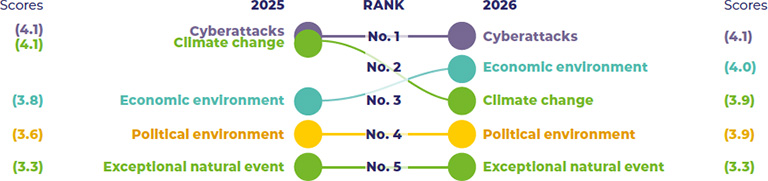
The risk ranking appears broadly stable compared to the previous edition, but this stability masks significant changes in the assessment of several major risks. For the ninth consecutive year, the risk of cyberattacks remains the primary threat to the industry and is still by far the most severe risk. Climate change, which tied for first place in 2025, has fallen to third place, just behind the risk related to the economic environment. These two risks are now closely followed by the political environment, the increase of which is one of the highlights of the 2026 edition, Following recent budgetary discussions around the role of life insurance.
Economic and political uncertainties at the heart of short-term concerns
The 2026 risk map highlights a significant increase in the assessment of risks related to the economic and political environments, in a context of increased uncertainty. Despite macroeconomic indicators that seem generally under control, tensions over international trade, the state of public finances and national and international political instability fuel a perception of higher risks. From an insurance perspective, this perception could only be reinforced by the content of the debates surrounding the 2026 budget, particularly given the punitive measures discussed with regard to life insurance in particular. Political risk, which now encompasses French, European and global dimensions, has seen the sharpest increase among all risks. This rise in political concerns is also reflected in the increase in the risk of inequalities and social conflict, related to recent episodes of violence and riots, the cost of which has been particularly high for the profession.
The main risks for insurance companies (score out of 5)
Technological risks remain central and are perceived as increasingly severe
Technological risks occupy a central place in the mapping. In addition to cyberattacks, there are now two rapidly growing risks: the risk associated with artificial intelligence, and the risk relating to data quality and IT process compliance. These risks are rising sharply in the ranking, particularly as a result of an increase in their estimated severity. This change reflects a shift in the perception of technological risk: while insurers believe they have a better grasp of the frequency of certain incidents, they anticipate potentially more serious impacts if they do occur, in a context of accelerating digital usage, cloud adoption and the deployment of artificial intelligence solutions.
A temporary decline in environmental concerns, without underminding climate risk as an overall challenge
In a context dominated by economic and political issues, environmental risks have fallen slightly in the 2026 ranking. Climate change nevertheless remains firmly established among the main risks facing the profession. The risk of exceptional natural events continues to have a specific profile, characterised by a low estimated frequency but high severity. This repositioning does not reflect a lasting decline in climate concerns, but rather a shift in the perception of short-term risk. In the long term, climate change remains identified as the most structural risk, likely to have a knock-on effect on many other risks, particularly economic and insurance risks.
Risks appear increasingly imminent
The 2026 edition confirms a striking phenomenon: the widespread shortening of the risk horizon. Almost all of the top 10 risks are now perceived as having a short-term horizon (0 to 2 years). Cyberattacks and the political environment are thus considered immediate risks by 99% of respondents. Conversely, analysis over a ten-year horizon reveals a shift in concerns towards three major areas: climate, the economy and technology. Climate change is becoming the central long-term concern, joined by the risk of uninsurability and issues related to artificial intelligence.
A differentiated interpretation of risks for businesses and threats to society
The 2026 risk map also highlights a clear distinction between the risks facing insurance companies and the threats identified for French society. In the short term, the hierarchies are similar, with political and economic risks carrying particular weight. In the long term, societal concerns appear more diverse, with greater emphasis on demographic, economic and climate issues. Finally, although insurers express serious concern about the country’s situation in the short term, their long-term outlook is significantly more confident, reflecting a perception of French society’s resilience and ability to adapt beyond the current turmoil.
Download
9th forward-looking Insurance and Reinsurance Risk Map (PDF)